Welcome to Hyperpolarized Carbon-13 MRI#
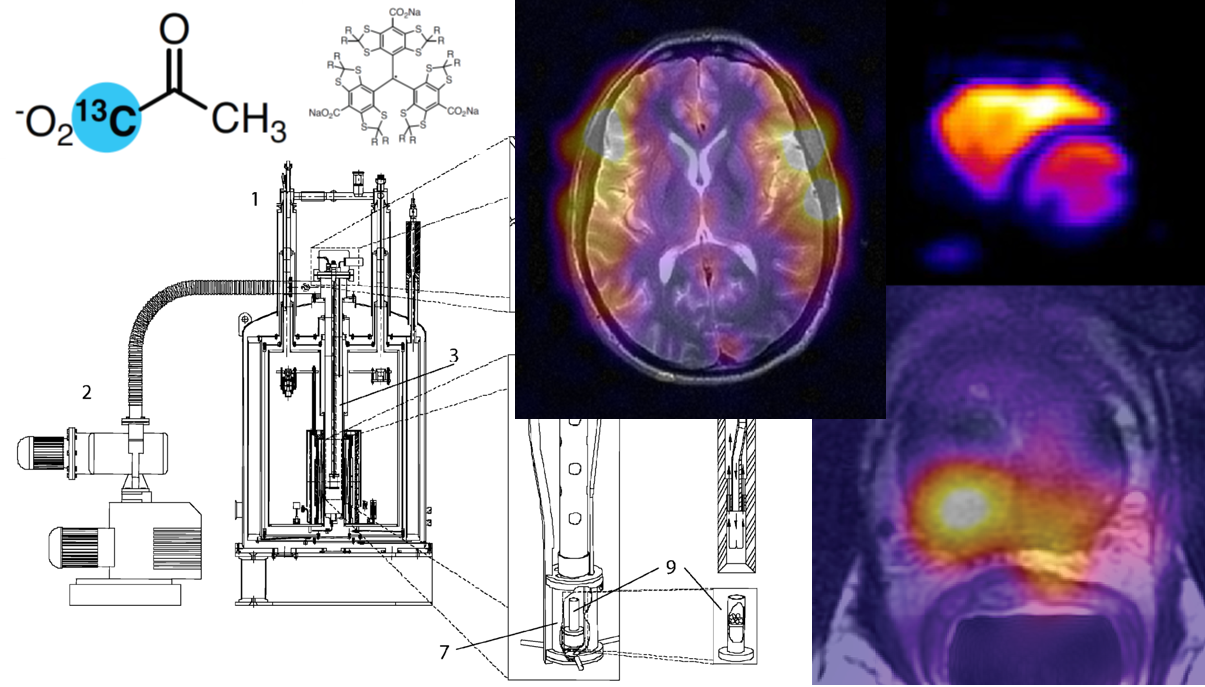
This is an educational book on hyperpolarized metabolic 13C MRI technology and biomedical applications.
Readers should be able to
Understand the concepts and techniques of dissolution dynamic nuclear polarization
Understand the NMR and in vivo behavior of hyperpolarized carbon-13 agents
Identify promising and potential applications of hyperpolarized carbon-13 MR
Design a hyperpolarized carbon-13 MR experiment
Perform a hyperpolarized carbon-13 MR experiment
Analyze and interpret hyperpolarized carbon-13 MR data This is not intended to be a review of all the literature (methods/techniques/etc), but rather should be more educational in focus, supporting the scientist who is new to hyperpolarized metabolic MRI without overwhelming them.
Audience: Scientists and Clinician-Scientists who want to work with hyperpolarized metabolic MRI methods.
Prerequisites: Familiarity with introductory college-level physics, chemistry, and math.
Citation#
Hyperpolarized Carbon-13 MRI. Editor: Peder E. Z. Larson.
Available online at: https://ucsf-hmtrc.github.io/hyperpolarized_mri_book/
doi: 10.5281/zenodo.15603048
Contributors#
Jan Ardenkjaer-Larsen, Department of Health Technology, Technical University of Denmark, Denmark
James Bankson, Department of Imaging Physics, The University of Texas MD Anderson Cancer Center
Myriam M. Chaumeil, Department of Physical Therapy and Rehabilitation Science, University of California, San Francisco, Department of Radiology and Biomedical Imaging, University of California, San Francisco
Arnaud Comment, Cancer Research UK Cambridge Institute, University of Cambridge, Cambridge, UK, General Electric Healthcare, Chalfont St Giles, UK
Adam P. Gaunt, Cancer Research UK Cambridge Institute, University of Cambridge, Cambridge, UK
Jeremy Gordon, Department of Radiology & Biomedical Imaging, University of California – San Francisco, San Francisco, CA, USA
Peder Larson, Department of Radiology and Biomedical Imaging, University of California, San Francisco
Justin Lau, Oxford Centre for Clinical Magnetic Resonance Research (OCMR), Division of Cardiovascular Medicine, Radcliffe Department of Medicine, University of Oxford, Oxfordshire, United Kingdom, Department of Physiology, Anatomy and Genetics, University of Oxford, Oxfordshire, United Kingdom, Small Animal Imaging Lab Core, H. Lee Moffitt Cancer Center, Tampa, Florida, United States
Jack J. Miller, The MR Research Centre & The PET Research Centre, Department of Clinical Medicine, Aarhus University, Aarhus, Denmark, Oxford Centre for Clinical Magnetic Resonance Research (OCMR), Division of Cardiovascular Medicine, Radcliffe Department of Medicine, University of Oxford, Oxfordshire, United Kingdom, Department of Physiology, Anatomy and Genetics, University of Oxford, Oxfordshire, United Kingdom, Department of Physics, Clarendon Laboratory, University of Oxford, Oxfordshire, United Kingdom
Michael A. Ohliger, Associate Professor, Department of Radiology and Biomedical Imaging, University of California, San Francisco
Renuka Sriram, Department of Radiology & Biomedical Imaging, University of California – San Francisco, San Francisco, CA, USA
Damian Tyler, Oxford Centre for Clinical Magnetic Resonance Research (OCMR), Division of Cardiovascular Medicine, Radcliffe Department of Medicine, University of Oxford, Oxfordshire, United Kingdom, Department of Physiology, Anatomy and Genetics, University of Oxford, Oxfordshire, United Kingdom
Cornelius von Morze, Assistant Professor, Mallinckrodt Institute of Radiology, Washington University
Pavithra Viswanath, Department of Radiology & Biomedical Imaging, University of California – San Francisco, San Francisco, CA, USA
Hikari A. I. Yoshihara, Laboratory for Functional and Metabolic Imaging, Institute of Physics, École Polytechnique Fédérale de Lausanne (EPFL), Lausanne, Switzerland