Preface#
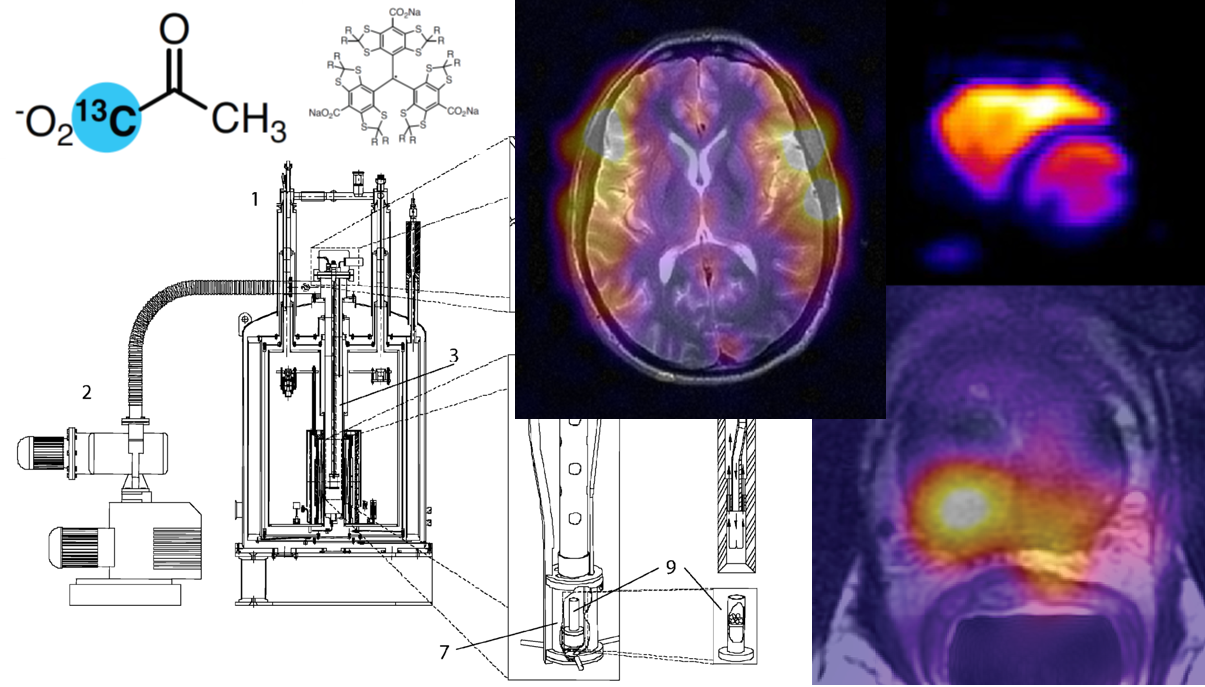
Are you ready to be hyperpolarized? Do you have what it takes to measure rapid in vivo metabolic conversion? In this book, you will be taken through a journey of samples being frozen at near absolute zero, irradiated with gigahertz frequency microwaves, dissolved by super-heated water, injected into a living organism, and illuminating in real-time metabolism and other biologically processes with 100,000+ times polarization enhancements in ways never possible before.
In other words, welcome to the exciting world of hyperpolarized carbon-13 magnetic resonance. Thanks for choosing this book, the authors and I have worked hard to provide a comprehensive, one-stop resource for those entering this area. We hope the content represents the current state-of-the-art, but this is still a relatively new and growing field, so expect the state-of-the-art to be constantly evolving.
This book was inspired by a seminar series at UCSF, started in 2011, designed to help new scientists enter the field of hyperpolarized carbon-13 magnetic resonance. One of the major challenges of this area is that arguably no one has the necessary background coming from typical undergraduate or even graduate education. The knowledge contained in these chapters is quite substantial and draws on understanding of physics, biology, chemistry, biochemistry, electrical engineering, mechanical engineering, and medicine. Even after almost 15 years working on hyperpolarized carbon-13 magnetic resonance, I learned an amazing amount as I edited the material in this book. Thus I consider this total knowledge in this book to be near the limit of what I would expect from an individual to fully comprehend. Look for strategic summaries at the beginning and endings of chapters to provide guidance for when the material becomes overwhelming, and consider drawing on additional fundamental resources for filling in knowledge gaps.
Organization#
The first half of this book focuses on the more fundamental concepts required for a hyperpolarized carbon-13 magnetic resonance experiment, including the physics, hardware, acquisition methods, experimental methods, imaging agents, and analysis. The final chapters describe how this technology is being used in the settings of cancer, neurology, the heart, and the liver to unveil new understandings and assessments of biology.
When starting out in this field, I recommend reading the first chapters in order – this provides logical transitions for the necessary physics and hardware to create HP agents, then how to acquire MR data and design experiments, and finally how to analyze data. However, there is not too much interdependency in the chapters and so they can be read in any order. If you start with later chapters, you may need to refer to the early fundamental concept chapters, and we have tried to highlight specific sections in the text.
Prerequisites#
This book is targeted at the level of a graduate student who has taken a course in principles of MRI and/or NMR, as this book does not cover the fundamentals of magnetic resonance which is crucial for these studies. For MRI background, we recommend Nishimura Principles of MRI, MRI: The Basics, and MRIQUESTIONS.com. For NMR, we recommend Bottomley and Griffiths Handbook of Magnetic Resonance Spectroscopy In Vivo: MRS Theory, Practice and Applications.
Given the breath of topics in this field, we also expect a general background in undergraduate-level physics, math, biology, and chemistry. This is both the challenge and opportunity of working in hyperpolarized carbon-13 magnetic resonance which is highly interdisciplinary.
Acknowledgements#
My greatest thanks to all the authors who contributed their expertise and time volunteering to support this work, they deserve the credit for all the content contained herein. This work would also not be possible without the continuing support of biomedical funding agencies throughout the world. In particular, the National Institute for Biomedical Imaging and Bioengineering (NIBIB) in the US National Institutes of Health (NIH) has generously supported a Biomedical Technology Resource Center, the Hyperpolarized MRI Technology Resource Center (HMTRC, P41EB013598, https://hyperpolarizedmri.ucsf.edu/) since 2011 which has been instrumental in supporting the development and dissemination of this technology.
Personally, I would like to acknowledge Prof. Dan Vigneron, who mentored me into this field as a post-doc and has been an exceptional colleague. Dan, along with Profs. John Kurhanewicz and Sarah Nelson went all-in as early adopters of hyperpolarized carbon-13 magnetic resonance, and were instrumental in the progress of this technology, as well as providing me amazing opportunities to work in this area. To acknowledge everyone else who has supported my journey in this field would require an entire chapter, and I feel so fortunate to have worked with many great scientists, engineers, clinical staff, and physicians. Thank you to everyone who has been a colleague, mentor, and trainee for your support and hard work!
Last but not least, I am so grateful to have had the support of my wonderful family. My parents inspired my passion for medical applications of engineering and placed my education as the highest priority. My children have given me purpose to make the world better for them, and always put a smile on my face. And my wife, Suzy, constantly helps me improve myself, is my greatest supporter, and my greatest inspiration.
I also welcome your feedback on this book, please don’t hesitate to reach out to me directly with any comments. Thanks to my unique name it shouldn’t be hard to track me down.
Enjoy, and happy hyperpolarizing! Peder